
A black hole is an area of space where gravity is so powerful that nothing, even light, can escape. The massive gravitational pull comes from an enormous amount of matter crammed into a very tiny space. Although black holes themselves are invisible, their existence is revealed by looking at how they influence surrounding matter and light.
Structure of a black hole
A black hole’s composition consists of the following:
•\tEvent horizon: This is the border or “surface” of a black hole. It is the point of no return after which the gravitational force is so extreme that escape is not possible.
•\tSingularity: At the black hole’s center is the singularity, a point of infinite density where matter is squished out of existence.
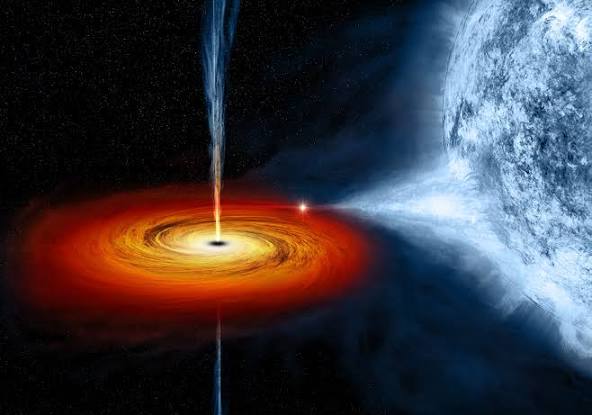
•\tAccretion disk: Around the event horizon of “feeding” black holes, there is a whirling disk of superheated gas and dust. As matter within this disk swirls, friction heats it up, making it shine brightly and producing X-rays and other radiation.
•\tErgosphere: Rotational black holes have an ergosphere, a zone of spacetime outside the event horizon where it is impossible to remain still. This is due to the intense gravitational frame-dragging effect.
How black holes are created
Scientists have discovered a number of ways black holes can be created:
•\tBlack holes resulting from the demise of extremely massive stars. When a star with a mass many times larger than our sun exhausts its nuclear fuel, its core collapses into itself due to its own weight, causing a supernova blast that is left with a black hole.
•\tSupermassive black holes weigh millions to billions of times that of our sun and are located at the center of nearly every galaxy. How they form is still a mystery, although potential theories include the collision of numerous smaller black holes or the direct collapse of giant clouds of gas in the early universe.
•\tIntermediate-mass black holes are a more recently established type, with a mass between stellar and supermassive black holes. They also have unclear modes of formation.
•\tPrimordial black holes are a theoretical black hole type that could have been created in the first few seconds after the Big Bang.
What happens inside a black hole
For an object or individual falling into a black hole, the experience would vary based on the black hole:
•\tFor a stellar-mass black hole, the huge tidal forces would “spaghettify” or stretch the body into a long, thin strand of atoms before it hit the singularity.
- For a supermassive black hole, tidal forces at the event horizon would be significantly weaker, and an observer could cross it without experiencing any noticeable effects. Once inside, however, the descent towards the singularity is unavoidable.
- Matter is squeezed into the infinitely dense singularity at the center once inside the event horizon. Because spacetime is warped, all routes converge to the singularity, so going back is impossible.
- The information paradox: From the outside world, information which has gone into a black hole seems to be irretrievably lost. This goes against the laws of quantum mechanics, and scientists have spent decades trying to overcome this “information paradox”.
AI answers can contain errors.
17 sites
- Black holes, explained – UChicago News
12-Oct-2022 — Black holes, demystified.. Black holes are areas of space in which a huge quantity of mass has been compressed into an extremely small vol.
University of Chicago News
• Black holes — All you want to know – Space
14-Feb-2025 — Natarajan’s work examines how black holes come into existence, develop, and create the universe, in addition to charting dark matter in cos.
Space
• A Study of Structure and Properties of Black Hole
There is general agreement that supermassive black holes reside in the center of a majority of galaxies.. Abstract- The configuration of a black hol.
International Journal of Science Engineering and Technology
Fundamental nature of black holes
A black hole is not an object but a spacetime region in which the pull of gravity is so strong that nothing, even light, cannot escape. This happens when an enormous amount of mass is packed into an impossibly small region, something predicted by Albert Einstein’s general theory of relativity. The gravity is so strong that it overpowers all the other forces.
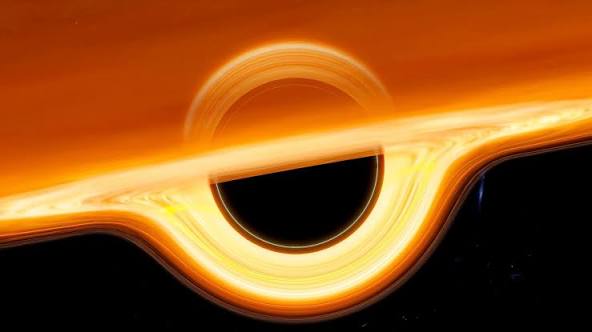
• Event Horizon: This is the black hole’s boundary, the point of no return. The escape velocity at the event horizon is equal to the speed of light, making escape impossible.
•\tSingularity: The center of the black hole, where matter is squeezed to a state of infinite density and zero volume, as per general relativity. Our physics fails at this point currently, and a complete understanding would need a theory of quantum gravity.
•\tAccretion Disk: As an actively “feeding” black hole, a disk of dust and gas swirls around it. The material in the disk is heated to prodigious temperatures by friction, which makes it radiate intense X-rays and other radiation.
- Ergosphere: In a rotating black hole, this is an area outside the event horizon where spacetime itself is being pulled in the direction of the rotation of the black hole. Objects in the ergosphere have to travel in the direction of the spin of the black hole.
Who Discovered the Black Hole?
No one discovered black holes, but their existence was predicted by John Michell in 1783, and the first mathematical solution to one was obtained by Karl Schwarzschild in 1916, working with Einstein’s general theory of relativity. Subrahmanyan Chandrasekhar is also a major figure, having demonstrated how massive stars might collapse, and Stephen Hawking and Roger Penrose made important later advances in our knowledge.
John Michell (1783): This English clergyman and scientist was the first to mathematically suggest the idea of a “dark star” so large that gravity would trap light, under Newtonian theory.
Karl Schwarzschild (1916): He discovered the first exact solution to Einstein’s field equations, which was a description of a spacetime region around a mass with an event horizon, a defining characteristic of a black hole.
Subrahmanyan Chandrasekhar (1930s): This Indian scientist showed that no force was strong enough to halt the collapse of a massive star after it had achieved a certain density, thereby proving black holes could exist in the real world.
J. Robert Oppenheimer and his students: In the late 1930s, they investigated the physics of the collapse of a large star, producing a model for a “black hole.”.
John Wheeler (1967): He is the one who first used the name “black hole” to refer to these objects.
Stephen Hawking and Roger Penrose: They provided important work to our understanding of black holes and their nature.
Also The Question people asked?
What exactly is inside a black hole?
Black holes have two parts. There is the event horizon, which you can think of as the surface, though it’s simply the point where the gravity gets too strong for anything to escape. And then, at the center, is the singularity. That’s the word we use to describe a point that is infinitely small and infinitely dense.
How long is 1 year in black holes?
A clock near a black hole will tick very slowly compared to one on Earth. One year near a black hole could mean 80 years on Earth, as you may have seen illustrated in the movie Interstellar. In this way, black holes can be used to travel to the future
Is black hole danger?
According to NASA, no black hole is close enough to be a danger to us. Plus, the sun is not massive enough to explode to form a black hole
Where will black hole take you?
Black holes are theorized to take you to a point of infinite density called a singularity at their center, where matter is crushed and you would be stretched and squeezed apart through a process called “spaghettification”. Once you cross the event horizon, there is no escape, and your matter merges into the singularity. While some theoretical models propose black holes could lead to other universes via wormholes, this is currently science fiction with no evidence to support it.
Are we 100% sure that black holes exist?
Observational evidence. Millions of black holes with around 30 solar masses derived from stellar collapse are expected to exist in the Milky Way. Even a dwarf galaxy like Draco should have hundreds. Only a few of these have been detected.
Could Earth survive a black hole?
If the Sun were replaced by an equally massive black hole, all the planets would remain in their present orbits, circling the black hole at a safe distance. Life would be impossible without the light and heat from the Sun, but at least Earth would survive.
What are scary facts about black holes?
5 black hole facts to blow your mind
- There are likely millions of black holes in our galaxy, and we will probably never know where they are. …
- If you fell into a black hole, you would never escape. …
- If you fell into a stellar-size black hole, you could turn into human spaghetti. …
- A black hole could fit in your pocket.
What did Stephen Hawking say about black holes?
A central law for black holes predicts that the total area of their event horizons – the boundary beyond which nothing can ever escape – should never shrink. This law is Hawking’s area theorem, named after physicist Stephen Hawking, who derived the theorem in 1971.
Can a black hole swallow a galaxy?
In short, no. There’s no way that a black hole could eat the universe, or even an entire galaxy, according to NASA. Here’s why. Black holes are former massive stars that have collapsed back in on themselves to become incomprehensibly dense — so much so that even light can’t escape them.
What would happen to your body if you fell in a black hole?
If a small black hole sucked you in, you would become a noodle before you got to the point of no return—called the event horizon. A big black hole is a million or billion times heavier than the sun. If you fall into one of those, you’d pass the event horizon before you started stretching.
How much is 1 minute in a black hole?
“If you were to stand just outside the event horizon of Sagittarius A*, and you stood there for one minute, 700 years would pass because time passes so much slower in the gravitational field there than it does on Earth.” Some have suggested that black holes could be used for time travel.
Is the Milky Way inside a black hole?
Observational evidence indicates that almost every large galaxy has a supermassive black hole at its center. For example, the Milky Way galaxy has a supermassive black hole at its center, corresponding to the radio source Sagittarius A*.
What is a black hole made of?
A black hole isn’t made of a material in the traditional sense but is rather a concentration of mass in a single point called a singularity. This singularity is the result of a massive star’s core collapsing under its own gravity, crushing all of its matter into a point of infinite density. What exists between the singularity and the event horizon is a region of spacetime with extremely intense gravity
Who discovered black holes?
The discovery of black holes is a story of evolving theory and evidence, with John Michell first proposing the concept in 1783 and Karl Schwarzschild later finding the first mathematical solution to it in 1916. Albert Einstein’s theory of general relativity was the framework that allowed for these predictions, while scientists like Subrahmanyan Chandrasekhar and Stephen Hawking made key contributions to our modern understanding of them.
- John Michell (1783): This English clergyman was the first to suggest that gravity could be so strong that even light could not escape, calling them “dark stars”.
- Karl Schwarzschild (1916): Using Einstein’s theory of general relativity, he found the first modern mathematical solution that described a black hole, including the “event horizon” boundary.
- Subrahmanyan Chandrasekhar (1930s): This physicist showed that very massive stars could collapse to form black holes at the end of their lives.
- David Finkelstein (1958): He first published the interpretation of a “black hole” as a region of space from which nothing can escape.
- Stephen Hawking and Roger Penrose: Both have made significant contributions to our understanding of the properties of black holes.
The term “black hole” was not coined until 1967 by physicist John Wheeler

