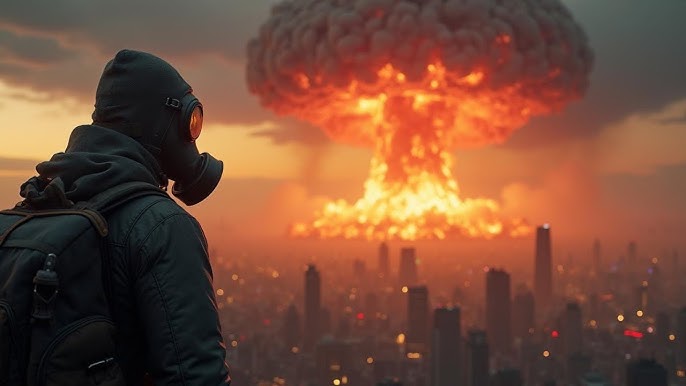
A nuclear war is a large-scale conflict where countries use nuclear weapons, the most destructive arms ever made. These weapons release enormous energy through atomic reactions, causing explosions that can wipe out entire cities, create deadly radiation fallout, and trigger firestorms and global power failures.Even a small nuclear war could kill millions, devastate the environment, and lead to “nuclear winter,” where sunlight is blocked and crops fail worldwide.So far, such a war has been avoided through Mutually Assured Destruction (MAD) — the understanding that if one nation uses nukes, others will retaliate, ensuring total destruction for all. Civilization has collapsed. The cities are gone, the electricity grid crashed, and almost all of the systems that formerly sustained modern society no longer function. From the ruins, a few survivors crawl into the light — to meet a world without infrastructure, technology, or organization. Is it possible for humanity to recover from scratch, or does this mark the last book in our story? Nobody knows where it started. Maybe some technical malfunction confused a radar pulse with a missile launch and prompted a chain reaction of retaliations. Perhaps it was a last-resort act of sabotage by some maverick military officer — or a trigger-happy remark by some world leader that ran out of control. Whatever the reason, World War III erupted and passed in an inferno of nuclear flames. Billions died. Cities were reduced to ash. And for the first time ever, human beings became an endangered species. The Survivors Some survived — those deep in the ground or beyond the blast areas. But even they were not safe. With the spreading of radiation, bunkers caved in, food and water supplies dwindled, and hopelessness ensued. Only the most well-prepared — or the luckiest — made it through the initial few weeks. Unlike what Hollywood envisions, the post-fallout world wouldn't be a wasteland for centuries. Contemporary nuclear weapons burn more hot and clean, so that levels of radiation can decline to lower, safer levels in weeks. Within a month or two, survivors would feel brave enough to venture outside. But what they'd see would be a horror: cities devastated, stillness where there had once been life, and nature taking everything back. Humankind had been pushed back millennia — to an era before electricity, communication, or international commerce. Survival would again be based on the most basic necessities: food, water, and shelter.

What If Humanity Had to Start Over After Civilization Collapsed

A nuclear war is a large-scale conflict where countries use nuclear weapons, the most destructive arms ever made. These weapons release enormous energy through atomic reactions, causing explosions that can wipe out entire cities, create deadly radiation fallout, and trigger firestorms and global power failures.Even a small nuclear war could kill millions, devastate the environment,…

Read More