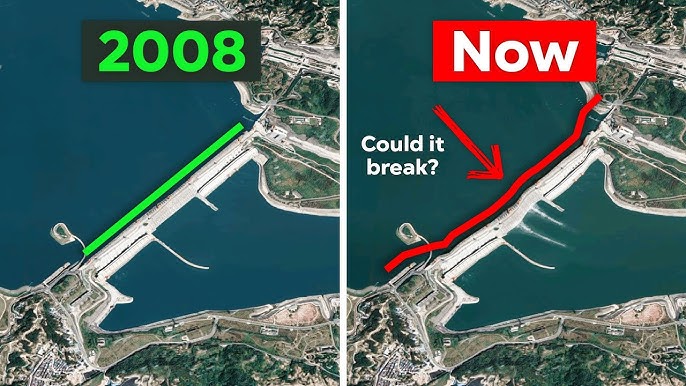
The Three Gorges Dam on the Yangtze River in Hubei Province, China, is the world’s largest hydroelectric power station with a combined capacity of 22,500 megawatts. Construction started in 1994 and was finally finished by 2012, ranking as one of the largest engineering projects in history. The 2,335-meter-long and 185-meter-high dam creates the enormous Three Gorges Reservoir, which extends more than 600 kilometers and can hold 39.3 billion cubic meters of water.
The dam performs a number of important functions. It generates vast amounts of clean electricity, cutting China’s reliance on coal and decreasing carbon emissions. It also controls flooding by managing the Yangtze’s flow, safeguarding millions of individuals and croplands downstream from periodic flooding. It has also enhanced navigation and commerce, as vessels can now travel through its five-stage locks and ship lift and journey safely and quickly deep within China’s interior.
Yet the project carried significant social and environmental burdens. More than 1.3 million persons were resettled to clear the way for the rising water reservoir, and many important archaeological and historical sites were inundated. The dam has reshaped the ecosystem of the river, impacting fish habitats, sediment transport, and generating enhanced landslide and low-magnitude earthquake hazard risks in the area.
In spite of all these problems, the Three Gorges Dam continues to be a testament to the engineering capability of China and an important component in China’s energy, transportation, and flood control systems. It is both a technological achievement and an indicator of the delicate interplay between human development and environmental protection.
why three gorges dam might be harmful to people
The Three Gorges Dam is potentially hazardous to human beings because of the possibility of a catastrophic failure, which will lead to devastating downstream flooding involving millions of people and essential infrastructure. Other threats include the possibility of reservoir-induced earthquakes and landslides and waterborne diseases, as well as the environmental and social impacts of the displacement of 1.4 million people and reservoir pollution.
Risks of dam failure
•\tDisastrous flooding: The flood resulting from a failure would be disastrous, affecting millions of people in downstream urban centers and towns instantly.
•\tInfrastructure damage: A failure would render vital infrastructure such as roads, bridges, and factories useless, crippling the economy of the region.
Geological and environmental hazards
•\tReservoir-induced earthquakes: The heavy weight of the reservoir’s water filling up the surrounding land increases pressure and can cause earthquakes.
•\tLandslides: The pressure of the water may cause heightened landslides along the reservoirs’ banks, which can create tsunami-like waves.
•\tPollution: The reservoir of the dam collects human and industrial wastes that poison the water and, in turn, create health issues and reduced biodiversity.
•\tWaterborne diseases: Alteration of water chemistry and the availability of pollutants create a rise in waterborne diseases.
Social risks
•\tMass displacement: The dam construction necessitated the displacement of about 1.3 to 1.4 million individuals, resulting in massive social disruption and suffering to many households, although some have improved their housing.
•\tLoss of cultural heritage: The flooding ruined many archaeological and architectural sites.

What is the world’s most powerful dam?
The Three Gorges Dam in Hubei, China, has the world’s largest instantaneous generating capacity at 22,500 MW of power. In second place is the Baihetan Dam, also in China, with a capacity of 16,000 MW. The Itaipu Dam in Paraguay and Brazil is the third largest with 14,000 MW of power.
Who thought of the Three Gorges Dam?
physician Sun Yat-sen
The plan to build the Three Gorges Dam dates back to the early 20th century. Chinese physician Sun Yat-sen came up with the idea of building the dam in 1919. He first described his vision in The International Development of China.
What happens if the 3 Gorges dam collapses?
If the one in one thousand chance of a dam collapse occurred, the millions of people who live downstream would be endangered.
Which dam in China slows the earth?
China’s Three Gorges Dam, the largest hydroelectric project in the world, has been found to slightly slow Earth’s rotation by 0.06 microseconds per day
What is the deepest dam in the world?
California: Parker Dam. What you see is not what you get at Parker Dam, known as “the deepest dam in the world.” Engineers, digging for bedrock on which to build, had to excavate so far beneath the bed of the Colorado River that 73 percent of Parker Dam’s 320-foot structural height is not visible.
What is the lifespan of the Three Gorges Dam?
The lifespan of the Three Gorges Dam will be beyond 100 years, Zhang Chaoran, an academician at the Chinese Academy of Engineering and an expert of hydropower-engineering, told the Global Times.
What does China think about the Three Gorges Dam?
China has admitted that the Three Gorges Dam has created a range of major problems that need solving quickly. Top leaders say the project has led to environmental problems and issues involving relocating 1.3m people. The Three Gorges is the world’s largest dam and could have cost up to $40bn
What is the deadliest dam failure in history?
In 1995, Human Rights Watch stated in its report that the death toll was approximately 230,000. In 2005, the Discovery Channel show Ultimate 10 rated the Banqiao Dam failure as the greatest technological catastrophe in the world, beating the Chernobyl nuclear disaster in the Soviet Union.


